System Architecture
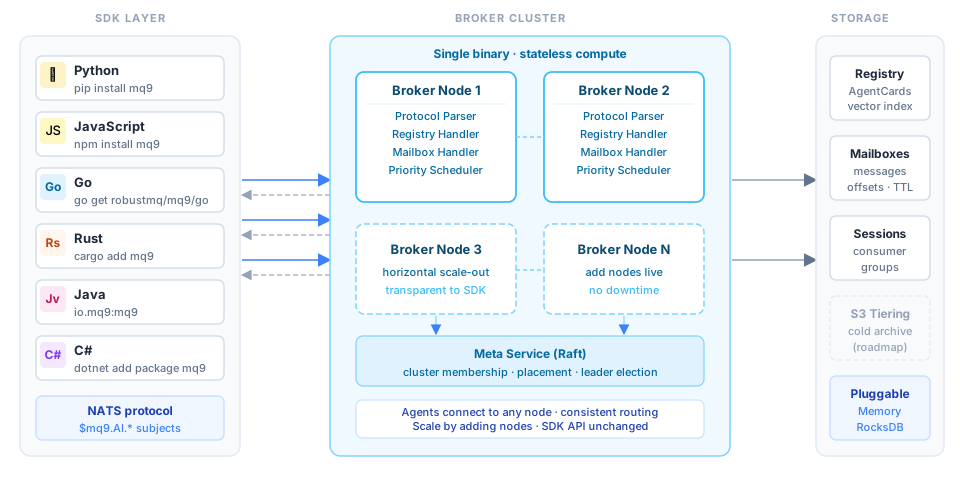
mq9 is composed of two parts: a multi-language SDK that agents and engineers use directly, and a Broker that handles all registry, messaging, and routing logic.
SDK Layer
The SDK is the only surface agents and services interact with. It wraps the NATS-based protocol into typed, language-idiomatic APIs — agents never send raw NATS requests directly.
Six official SDKs are provided:
| Language | Package | Install |
|---|---|---|
| Python | mq9 | pip install mq9 |
| JavaScript / TypeScript | mq9 | npm install mq9 |
| Go | github.com/robustmq/mq9/go | go get github.com/robustmq/mq9/go |
| Rust | mq9 | cargo add mq9 |
| Java | io.mq9:mq9 | Maven / Gradle |
| C# | mq9 | dotnet add package mq9 |
All six SDKs expose an identical API surface. Adding a new protocol operation means updating all six simultaneously — there is no per-language divergence.
Transport: Every SDK communicates with the broker using the NATS protocol over $mq9.AI.* subjects. Any environment that can open a TCP connection to port 4222 can connect.
Broker
The broker is a single binary with no external runtime dependencies. It handles three concerns:
Protocol and routing
Receives all SDK requests over NATS, routes them to the correct internal handler: registry operations (AGENT.REGISTER, AGENT.DISCOVER, etc.) or messaging operations (MSG.SEND, MSG.FETCH, MSG.ACK, etc.).
Agent Registry
Maintains the AgentCard index. Supports both full-text keyword search and semantic vector search over capability descriptions. TTL-based auto-expiry removes stale registrations.
Reliable Async Messaging
Manages persistent mailboxes. Stores messages server-side, applies priority ordering (critical > urgent > normal), tracks consumer group offsets, and enforces message-level and mailbox-level TTLs.
Cluster Mode
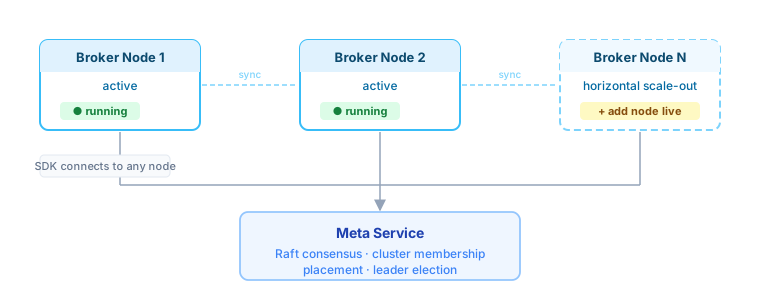
A single broker node handles millions of concurrent agent connections. When throughput or availability requirements grow, the broker scales horizontally.
Key properties of the cluster:
- All nodes are active — there is no primary/standby split. Agents can connect to any node.
- Consistent routing — the Meta Service (Raft-based) handles cluster membership, placement decisions, and leader election.
- Transparent scale-out — add a new broker node and it joins the cluster live. No downtime, no reconnection required from the SDK side.
- Unchanged API — the SDK connection string points to the cluster (or a load balancer in front). The API is identical whether there is one node or twenty.
When to scale
| Scenario | Approach |
|---|---|
| Development / testing | Single node (docker run robustmq/robustmq) |
| Production, moderate load | Single node with persistent volume |
| High throughput / HA requirement | 3+ node cluster behind a load balancer |
| Data sovereignty / multi-region | Separate deployments per region; federation (roadmap) |
Storage
The broker's storage layer is pluggable:
| Backend | Use case |
|---|---|
| Memory | Development, testing — no persistence |
| RocksDB | Production — durable, low-latency local storage |
| S3 Tiering | Cold archive for high-volume deployments (roadmap) |
Storage is decoupled from compute. In cluster mode, storage can scale independently of the broker nodes.
Deployment
Single node (development)
docker run -d --name mq9 -p 4222:4222 -v mq9-data:/data robustmq/robustmq:latestSingle node (production)
docker run -d \
  --name mq9 \
  -p 4222:4222 \
  -p 9090:9090 \
  -v /data/mq9:/data \
  --restart unless-stopped \
robustmq/robustmq:latest- Port
4222— mq9/NATS protocol (SDK connections) - Port
9090— Prometheus metrics
Cluster deployment
Refer to the RobustMQ cluster deployment guide for multi-node configuration. The SDK server parameter accepts a comma-separated list of node addresses or a load balancer URL — no code change is required when moving from single-node to cluster.